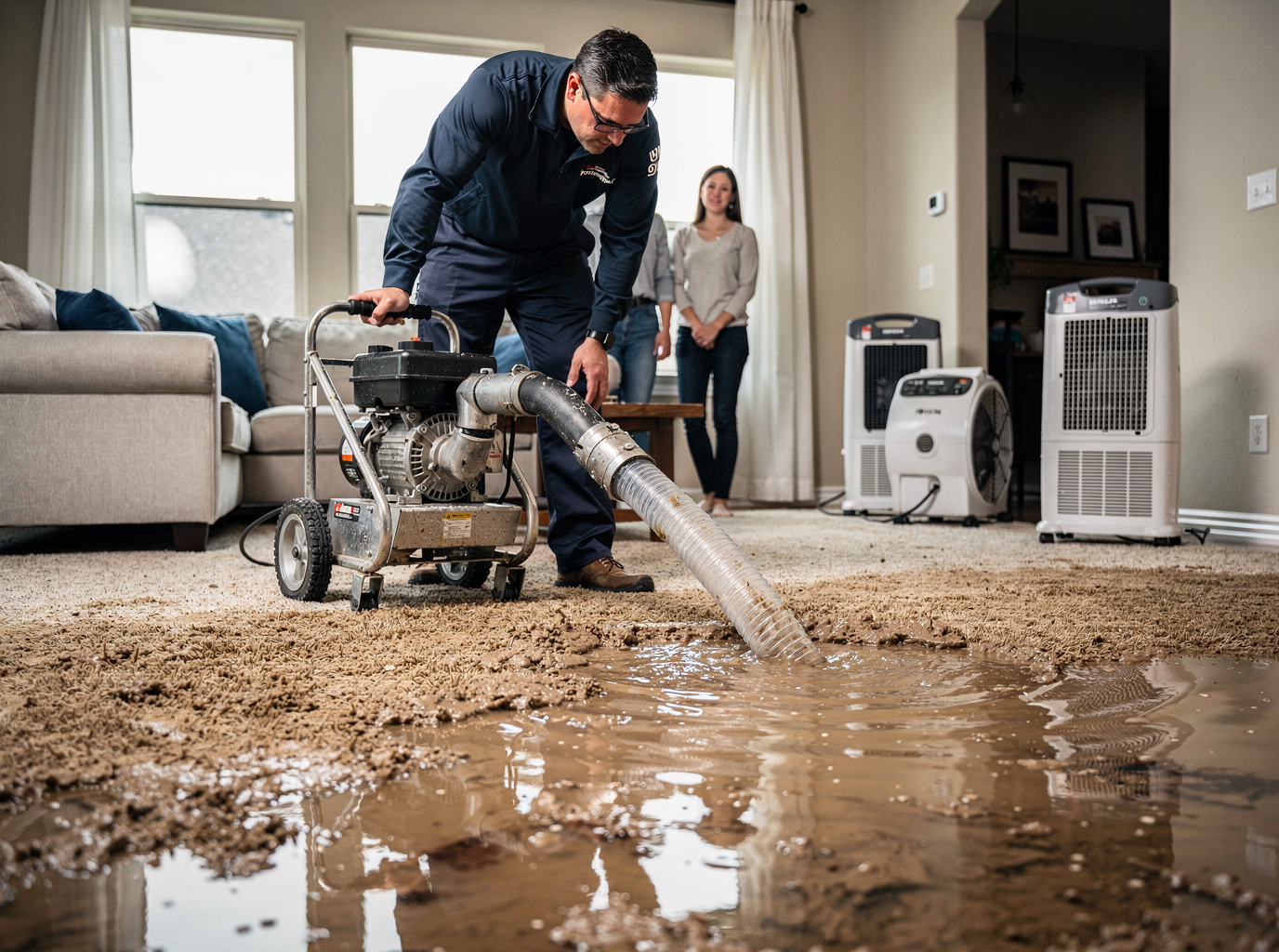
Thunderstorms rolling through Grand Prairie during hot summer months often dump several inches of rain in under an hour, overwhelming gutters and low-lying lots near Lone Star Park. Older slab homes in Lake Ridge and Grand Peninsula commonly see water push under door thresholds and into HVAC returns because the local clay soil expands and holds moisture. Technicians arrive with truck-mounted extraction units that pull standing water before it migrates into wall cavities or under cabinets.
Once bulk water is removed, the job shifts to hidden moisture behind baseboards and under engineered flooring, which is common in homes built after the 1990s near Grand Prairie Premium Outlets. Infrared meters locate pockets that standard fans miss, and air movers are positioned to create negative pressure so vapor does not travel into adjacent rooms. Dallas County building codes require documentation of moisture readings below 15 percent before walls can be closed, which changes drying timelines after each storm event.
Edge cases include sewage-tinged water from backed-up street drains during prolonged rain and appliance leaks that soak particleboard subfloors in split-level homes. In both situations, removal includes separating affected materials on site rather than leaving them to off-gas later. Crews document every step with photos and meter logs so homeowners have records for insurance adjusters working in the Dallas area.
Technician insight
In Grand Prairie the thing that catches most people out with Emergency Water Removal is how the clay soil around Lake Ridge and Grand Peninsula keeps pulling moisture back into slabs long after the rain stops. Homeowners often stop fans too soon and the water returns under baseboards. We always run meters for three full days after extraction because local thunderstorms hit again before the ground dries.
Lake Ridge Storm Flood
Heavy rain from a summer thunderstorm pushed water under the front door of a 1990s home in Lake Ridge. Extraction units cleared three inches of standing water from the living room and hallway within ninety minutes. Hidden moisture was found under the kitchen cabinets and behind the HVAC closet; targeted drying continued for four days until readings dropped below fifteen percent.
Emergency Water Removal Services We Offer
✓Storm Flood Extraction
Truck-mounted pumps remove standing rainwater from yards and interiors after thunderstorms hit Lake Ridge and Grand Peninsula properties.
✓Appliance Leak Water Removal
Immediate extraction around failed water heaters, washing machines, and refrigerators before moisture reaches subfloors in Grand Prairie homes.
✓Basement and Crawlspace Drying
Portable extractors and dehumidifiers clear water from below-grade spaces common in older Dallas County neighborhoods after heavy rain.
✓Carpet and Pad Extraction
Water is pulled from carpet and padding on site, with pads removed when saturation exceeds what can be dried without mold risk.
✓Roof Leak Emergency Removal
Tarps and interior extraction stop water from ceiling leaks caused by wind-driven rain near Grand Prairie Premium Outlets.
Emergency Water Removal Cost in Grand Prairie, TX
| Service | Typical Range | What Affects It |
|---|---|---|
| Initial Assessment And Extraction | $250–$600 | Varies with water depth and travel time from 2202 113th St |
| Per Room Drying Setup | $150–$350 | Includes equipment placement and daily monitoring |
| Carpet Pad Removal | $100–$250 | Per room when saturation requires disposal |
| Extended Dehumidification | $75–$150 | Per additional day after first 48 hours |
Ranges are typical for Grand Prairie, TX and confirmed with an exact written quote before any work starts.
How it works
- 1
On-Site Assessment
Technicians measure standing water depth, locate hidden moisture with infrared cameras, and note affected materials in Lake Ridge or Grand Peninsula homes.
- 2
Bulk Water Extraction
Truck-mounted and portable pumps remove standing water within the first hour to limit migration into walls and under slabs.
- 3
Targeted Drying Setup
Air movers and dehumidifiers are placed based on meter readings, with daily checks to track moisture reduction in Dallas County clay soils.
- 4
Final Moisture Verification
Readings below 15 percent are documented before equipment is removed and the homeowner receives a written drying log.
Pricing
Upfront quotes are given after the initial assessment; final cost depends on water volume, access, and number of affected rooms.